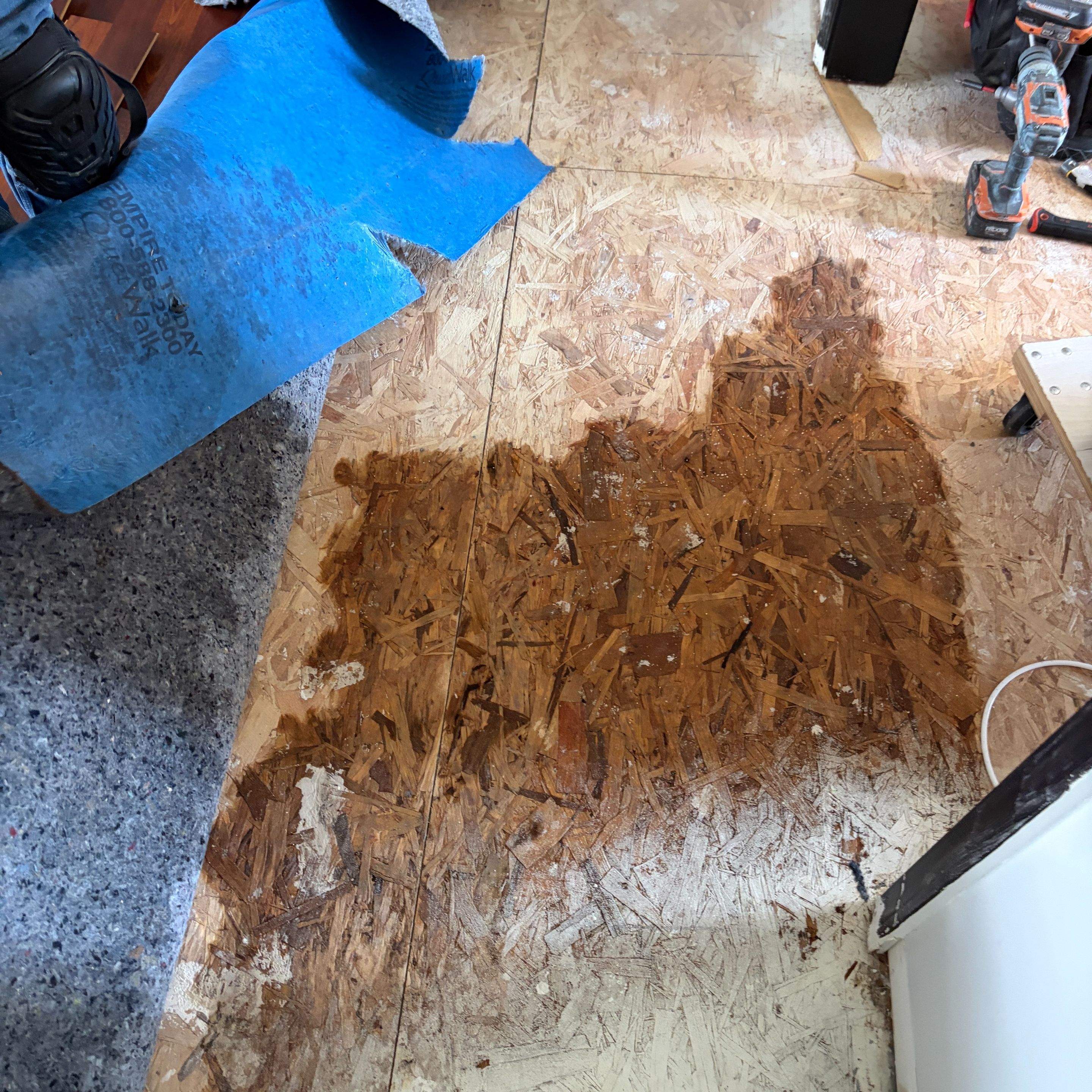
Step 1: Verify the Water Category Before You Touch Anything
Before any drying begins, classify the water. This is not optional. It dictates whether DIY work is safe at all.
- Category 1 (clean): Supply line break, ice maker line, sink overflow with no contaminants. DIY drying is possible if addressed within 24 to 48 hours.
- Category 2 (grey): Dishwasher discharge, washing machine drain, aquarium. Requires extraction and antimicrobial treatment. Marginal for DIY.
- Category 3 (black): Sewage, toilet trap backflow, flood water, any standing water older than 72 hours. Not a DIY situation under any circumstance.
Review the breakdown in our water damage category guide if you are unsure. Misclassifying Category 3 as Category 1 is the single most common DIY mistake we see in Rossville. A second common error is assuming Category 1 water stays clean. Once supply water sits on flooring for more than 24 hours, contacts drywall paper, or passes through ceiling cavities, it degrades to Category 2 by definition.
Step 2: Shut Off the Source and Document the Scene
- Close the main water valve or the localized shutoff for the failed fixture.
- Cut electrical power to the affected zone at the breaker if water is within 3 feet of any outlet.
- Photograph every wall, baseboard, floor, and ceiling section before moving anything. Include wide shots and close-ups.
- Record the time the leak started, the time it was discovered, and the approximate gallons involved.
- Save the failed component (burst hose, cracked valve, supply line) in a sealed bag for the adjuster.
- Note the brand, model, and age of any appliance involved.
Documentation matters for insurance. Our water damage insurance claim process guide covers exactly what adjusters expect.
Step 9: Know the DIY Stop Points
Stop drying yourself and call a certified crew if any of the following occur:
- Moisture readings plateau for more than 48 hours.
- Any musty odor develops at any point.
- Drywall remains above 18 percent moisture after 72 hours of equipment runtime.
- The affected area exceeds 150 square feet of flooring.
- Water reached subfloor, wall cavities exceeding 24 inches in height, or insulation in more than one bay.
- Hardwood flooring shows cupping, crowning, or buckling.
- The loss involves a multi-story path where water traveled through a ceiling assembly.
Step 10: When to Call Rossville Water Restoration
If any stop point is triggered, dispatch is the next move. Rossville Water Restoration crews in Rossville respond within 2 hours in most cases, arrive with truck-mounted extraction, multiple LGR units, and thermal imaging to confirm cavity moisture.
- Have your category determination, photos, and moisture logs ready at the door.
- Identify shutoff locations and breaker panel access for the technician.
- Clear a 3 foot path to the affected zone for equipment staging.
- Expect a written scope, drying plan, and daily moisture documentation through completion.
Step 3: Remove Standing Water Within 60 Minutes
- For volumes under 5 gallons, use towels and a standard wet/dry shop vacuum with a minimum 6 gallon tank.
- For volumes between 5 and 25 gallons, plan on 2 to 4 hours of continuous extraction with a shop vac, emptying every 15 minutes.
- Anything over 25 gallons of standing water exceeds DIY equipment capacity. Call for truck-mounted extraction.
Wet carpet retains roughly 0.5 to 1 gallon per square yard. A 10 by 12 foot room of soaked carpet can hold 12 to 15 gallons even after surface extraction. The pad underneath holds another 1 to 2 gallons per square yard and rarely dries in place. In most water losses, pad replacement is faster and cheaper than extended drying attempts.
Step 4: Remove Wet Materials That Cannot Be Saved In Place
- Lift area rugs and move them to a hard surface for separate evaluation.
- Pull baseboards in affected rooms. Score the caulk line with a utility knife first to avoid drywall tear-out.
- Cut drywall 12 to 16 inches above the visible water line using a horizontal chalk line. Drywall wicks moisture vertically.
- Remove and discard wet insulation. Fiberglass loses R-value permanently once saturated.
- Detach toe-kicks under cabinets to expose the cavity behind.
- Drill 1 inch weep holes at the bottom of wall cavities you intend to dry in place, spaced every 16 inches on center.
- Remove door casings if water tracked into the jamb assembly.
Step 6: Deploy Airflow at Correct Volume
- Use a minimum of one high-velocity air mover per 50 to 70 linear feet of wall, angled at 15 to 45 degrees toward the wet surface.
- Rental axial fans should deliver at least 2,800 CFM. Box fans do not generate enough velocity to evaporate trapped moisture.
- Position movers in a clockwise pattern around the room to create circulation, not opposing flow.
- Run continuously for a minimum of 72 hours. Do not shut equipment off overnight.
- Reposition movers every 24 hours by 6 to 8 feet to prevent dead zones along the perimeter.
Step 7: Control Humidity With a True LGR Dehumidifier
- Target relative humidity: 30 to 50 percent inside the drying chamber.
- A consumer 50 pint dehumidifier removes roughly 30 pints per day under real conditions, which is undersized for any flood over 100 square feet.
- Rent a low grain refrigerant (LGR) unit rated for 70 to 130 pints per day. Cost runs $60 to $120 per day in most Rossville rental yards.
- Drain to a condensate pump or a floor drain. Do not rely on the internal bucket.
- Place the dehumidifier centrally in the chamber, not against a wall, so intake and exhaust airflow are not blocked.
Step 8: Measure Moisture, Do Not Guess
- Buy or rent a pin-type moisture meter ($40 to $150 range).
- Take a baseline reading in an unaffected room. Drywall should read 12 to 16 percent. Wood framing should read 8 to 15 percent.
- Log readings in the wet area every 24 hours at the same locations.
- Drying is complete when wet-area readings match the unaffected baseline for two consecutive days.
- Also log chamber temperature and relative humidity at each check. A drop in RH without a drop in material moisture indicates trapped water behind a surface.
If you suspect moisture behind surfaces that look dry, review the indicators in our guide on signs of hidden water damage.
Step 5: Establish the Drying Chamber
Containment concentrates your airflow and dehumidification. Without it, you are trying to dry the entire house.
- Close doors and windows in the affected zone.
- Seal HVAC supply and return vents in the wet area with plastic and tape.
- Hang 6 mil poly across open doorways if you must isolate part of a larger room.
- Target chamber size: keep the affected area under 400 square feet per dehumidifier.
- Maintain interior chamber temperature between 70 and 90 degrees Fahrenheit. Evaporation rate drops sharply below 70.